

You know, music creation has always been about connection, right? Meeting people, sharing ideas, making something cool together. Well, things are getting wild because AI is jumping into the studio. It's not just about making beats anymore; it's about how we actually work together. Think of it like this: AI is becoming a new kind of bandmate, a co-pilot, and even a way to jam with people across the globe. Let's check out how these AI-driven music collabs are changing the game.
Key Takeaways
- AI can help you find other musicians who fit your style, almost like a matchmaking service for bands.
- Think of AI as a creative partner that sparks new ideas, rather than a replacement for your own talent.
- You can now easily work on music with people anywhere in the world, with AI smoothing out the technical stuff.
- AI tools can handle a lot of the boring admin tasks, leaving you more time to focus on the actual music.
- Embrace the unexpected; sometimes AI's 'mistakes' or unique outputs can lead to something truly original.
Finding Your Sonic Soulmate: AI's Matchmaking Magic
Remember the old days? You'd meet someone at a gig, maybe a friend of a friend, and bam, a musical partnership was born. It was all about luck, right? Well, AI is here to throw a digital wrench into that serendipity machine and give it a serious upgrade. Think of AI as your super-powered, slightly nerdy matchmaker, but instead of finding you a date, it's finding you the perfect musical collaborator.
From Serendipity to Smart Suggestions
Gone are the days of hoping you'll bump into the right guitarist at the local dive bar. AI can now sift through mountains of data – genres, playing styles, even your secret love for obscure 70s funk – to suggest people you'd actually click with musically. It's like a dating app for musicians, but way less awkward and with a much higher chance of producing a killer track. You can even get suggestions based on what you're working on. If you've got a killer synth line but need a drummer who can lay down a beat that sounds like it came straight out of a classic hip-hop track, AI can help you find that person, no matter where they are on the planet. It’s a bit like having a digital A&R scout working for you 24/7.
Beyond Borders, Beyond Genres
This is where things get really wild. AI doesn't care if you're in Nashville and your ideal collaborator is in Tokyo. It breaks down geographical barriers like they're made of tissue paper. Suddenly, you're not limited to the musicians in your immediate vicinity. You can connect with someone who specializes in a genre you've only dreamed of exploring, or someone whose unique perspective can push your music into totally uncharted territory. It's like opening up a global studio session without ever leaving your room. You might even find yourself working with artists who are using tools like OpenAI's music projects, pushing the boundaries of what's possible.
The Digital A&R Department
So, how does this magic actually happen? AI platforms can analyze your existing music, your influences, and even your stated goals. Then, they compare that to a vast database of other musicians and their work. It's not just about matching genres; it's about finding complementary skills and creative energies. Imagine this: you're a singer-songwriter who needs a producer who can add some electronic flair. AI can identify producers who excel in that specific niche, perhaps even ones who have worked on similar projects. It's about finding that sonic soulmate who elevates your music from good to absolutely mind-blowing. This process can feel like having a whole team of experts helping you out, all thanks to smart algorithms.
Your New Bandmate: AI as a Creative Co-Pilot
Sparking Inspiration, Not Replacement
Okay, let's get real. The idea of an AI bandmate might sound like something out of a sci-fi flick, but it's actually way less about robots taking over and more about having a super-powered assistant. Think of it like this: you're stuck on a melody, staring at your DAW like it's personally offended you. Instead of banging your head against the wall, you can ask an AI to throw some ideas your way. It's not going to write your next hit single for you (unless you want it to, which is a whole other conversation!), but it can definitely nudge you out of that creative rut. The goal here is to augment your own genius, not to replace it. It’s like having a brainstorming buddy who never sleeps and has heard literally every song ever made.
Jamming with Algorithms
So, how do you actually 'jam' with a bunch of code? It’s pretty wild. You can feed an AI your existing tracks, tell it what vibe you’re going for – maybe something like "chill lo-fi beats with a hint of 80s synthwave" – and it can spit out drum patterns, basslines, or even chord progressions that fit. You're still the boss, though. You can pick and choose what you like, tweak it, or just use it as a jumping-off point. It’s a back-and-forth, a digital call-and-response. You might find yourself saying, "Hmm, that bassline is cool, but can you make it funkier?" and the AI just… does it. It’s a way to explore sonic ideas you might never have stumbled upon on your own.
Unlocking Uncharted Sonic Territories
This is where things get really interesting. AI doesn't have the same hang-ups or genre biases that humans sometimes do. It can blend styles in ways that might seem totally bizarre at first, but often end up sounding incredibly fresh. Imagine a jazz improvisation meeting a glitchy electronic beat, or a folk melody layered over a trap rhythm. The AI can help you find those unexpected connections, pushing your music into places you wouldn't have thought to go. It’s about breaking free from your usual patterns and discovering new sounds that are uniquely yours, with a little help from your digital pal. It’s less about following rules and more about seeing what happens when you throw different sonic ingredients into the digital pot.
The Global Studio Session: AI-Driven Music Collabs
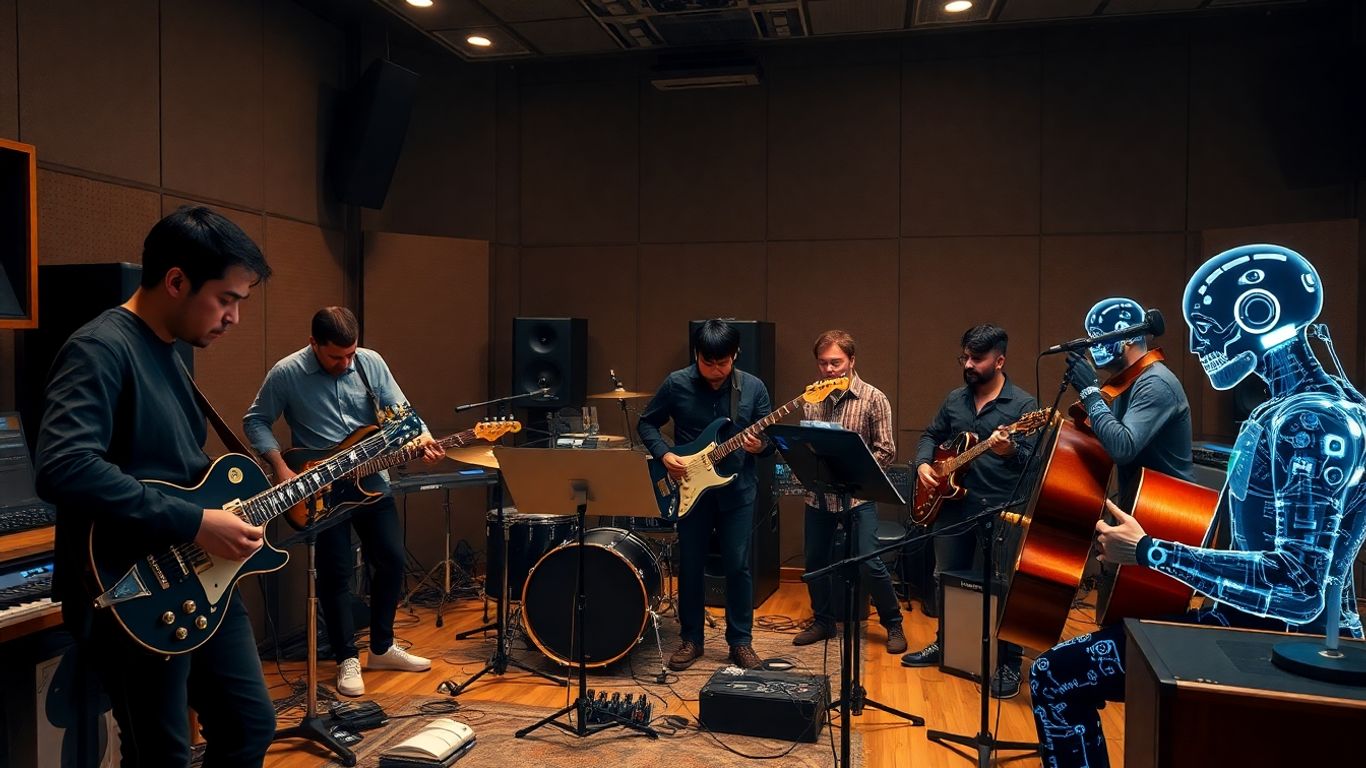
Remember when jamming with someone meant you both had to be in the same room, breathing the same air, and probably arguing over who gets the last slice of pizza? Well, those days are getting a serious AI upgrade. Now, you can literally have a studio session with folks scattered across the planet, all thanks to some clever tech.
Real-Time Remixes Across Continents
Imagine this: you lay down a killer guitar riff in your home studio in, say, Boise. You upload it, and within minutes, an AI tool sends it over to your collaborator in Tokyo, who adds a funky bassline. Then, it zips to Berlin, where another AI helps a vocalist lay down some ethereal harmonies. This isn't science fiction; it's happening now. AI can help sync up these disparate tracks, making it feel like you're all in the same room, even if your "room" is the entire internet. It’s like a super-powered, global game of musical telephone, but instead of a garbled mess, you get a polished track.
Automated Polish for Remote Projects
Let's be real, coordinating schedules across time zones is a nightmare. And then there's the technical stuff – making sure everything sounds good together. AI is stepping in to smooth out these rough edges. Think of it as your virtual studio assistant who never sleeps. It can help with mixing, mastering, and even suggesting sonic adjustments to make sure your international jam session sounds professional. You can upload your parts, and the AI can work its magic, tidying things up so you can focus on the art, not the admin.
Democratizing International Artistry
Before AI, creating music with people far away often meant expensive travel, complicated logistics, and big studio budgets. Now, it's way more accessible. You don't need a record label's backing to work with someone across the ocean. AI tools are lowering the barrier to entry, allowing more musicians, regardless of their location or financial situation, to connect and create together. It's a fantastic way to break down geographical barriers and discover new sounds from different cultures. Who knows, your next big hit might be a collaboration with someone you've never even met in person, all thanks to a little help from our AI friends.
The beauty of these AI-driven collaborations is that they can turn what used to be a logistical headache into a creative playground. It’s about making music creation more inclusive and less dependent on physical proximity or traditional studio setups. The world just got a whole lot smaller for musicians.
Here's a quick look at how it can work:
- Step 1: Record your musical part (vocals, instrument, beat).
- Step 2: Upload it to a collaborative AI platform.
- Step 3: The AI helps sync, mix, and master your contribution with others.
- Step 4: Review and refine the combined track with your global bandmates.
It’s a pretty neat way to get a professional sound without all the usual fuss.
From Admin Annoyances to Artistic Awesomeness
Okay, let's be real. Nobody got into music to spend hours wrestling with tedious tasks. You want to make noise, create magic, and maybe get a little famous. The good news? AI is here to be your ultimate studio sidekick, swooping in to handle the boring stuff so you can get back to the fun part.
Streamlining the Studio Grind
Think about all those little things that eat up your creative time. AI can actually help here. It’s like having a super-organized assistant who never needs coffee breaks. Need to sort through a mountain of takes? AI can help flag the best ones. Trying to get your tracks sounding polished but don't have a mastering engineer on speed dial? AI mastering tools are getting seriously good, offering a quick way to make your music sound professional without breaking the bank.
Automating the Nitty-Gritty
This is where AI really shines for the less glamorous side of music. We're talking about tasks like:
- Generating basic chord progressions: Stuck on a bridge? AI can spit out a few ideas to get you moving.
- Creating placeholder drum beats: Need a rhythm track to jam over while you figure out the real one? AI can do that in seconds.
- Transcribing audio: Trying to figure out that complex bassline your favorite artist played? AI can help transcribe it for you.
- Writing basic press releases or social media blurbs: Yep, even the marketing stuff can get a boost.
It's not about replacing your unique touch; it's about removing the roadblocks. The goal is to let AI handle the repetitive, time-consuming bits so you can focus on the creative decisions that truly matter.
More Time for the Melody
Ultimately, all this automation and streamlining means one glorious thing: more time for you. More time to experiment with that wild synth sound, more time to tweak that vocal melody until it’s perfect, more time to just play and explore. AI isn't here to steal your artistic soul; it's here to give you back the hours you'd otherwise lose to administrative headaches. So, embrace the tech, let it handle the grunt work, and go make some awesome music. Your future, less-stressed self will thank you.
The Uncanny Valley of Sound: Embracing AI's Quirks
Okay, so sometimes AI music can sound a little... off. You know that feeling? It's like it's almost right, but something's just not quite there. This is what folks are calling the "AI ick" – that weird sensation when something feels a bit hollow, lacking that certain something that makes music truly connect. It's not necessarily bad, just... different. Think of it like a slightly off-key note that somehow works, or a rhythm that's just a hair too syncopated. These aren't always mistakes; they can be the sparks that ignite something new.
When 'Mistakes' Become Masterpieces
Remember when early AI music sounded like it was made by a robot with a cold? Yeah, we've come a long way. But even now, the AI can throw you a curveball. Maybe it's a weird chord progression, a vocal effect that's a bit too processed, or a beat that feels slightly out of place. Instead of hitting delete, try leaning into it! Sometimes, these unexpected moments are what make a track stand out. It’s like finding a cool, unexpected texture in a painting. You can even train AI models with specific sounds to create totally unique sonic palettes. It’s all about playing with what the AI gives you, even if it’s not what you initially expected. It’s a wild ride, and sometimes the best discoveries happen when you least expect them.
Curating Unique Sonic Palettes
Think of AI as your super-powered, slightly eccentric collaborator. You can feed it specific sounds, styles, or even just a mood, and it'll come back with something you might not have dreamed up yourself. Want a blend of 80s synth-pop with a touch of Mongolian throat singing? AI can give it a shot. It’s like having a massive sound library at your fingertips, but with the added bonus of unexpected combinations. You can even use AI tools to generate variations on a theme, helping you explore different sonic directions without hours of manual tweaking. It’s a fantastic way to break out of your usual creative habits and stumble upon something fresh. Check out some of the amazing tools available for AI music generation to get a feel for what's out there.
The Art of the Unexpected
So, what happens when the AI goes rogue? Instead of getting frustrated, try to see it as an opportunity. Maybe that glitchy vocal sample is the hook you never knew you needed. Perhaps that slightly off-kilter drum pattern is the perfect groove for your new track. It’s about embracing the weirdness. The music industry is already seeing artists experiment with these AI quirks, turning what might seem like flaws into defining characteristics. It’s a bit like jazz improvisation – you take a wrong note and turn it into something brilliant. This willingness to experiment is key to pushing musical boundaries. You might find that the most memorable parts of your song come from the AI's little surprises.
Who's the Artist? Navigating the New Creative Landscape

So, you've been jamming with AI, maybe even letting it cook up some beats or melodies. It’s pretty wild, right? But then the big question pops up: when you’re working with these digital muses, who’s actually the artist? Is it you, the human with the vision, or the code that’s spitting out the sounds? It’s a bit like asking who painted the Sistine Chapel – Michelangelo, or the guy who mixed the paint? Well, maybe not that dramatic, but you get the idea.
AI-Generated 'Bands' and Viral Tracks
You’ve probably seen them – those AI-generated artists or songs that suddenly blow up online. They might sound eerily familiar, or completely out there, but they’re popping up everywhere. It’s like a whole new genre of music is being born, not from a sweaty garage band, but from a server farm. These digital acts can churn out content at a speed that’s frankly astonishing. One minute, there’s nothing; the next, you’ve got a whole discography and a fanbase. It’s a bit like a pop-up shop, but for music, and it’s changing the game for how we discover and consume tunes.
Transparency in the Age of Algorithms
This is where things get a little… fuzzy. If an AI helped write the lyrics, arrange the track, and even generate the vocals, how much of it is yours? It’s becoming super important to be upfront about the tools you’re using. Think of it like a recipe: you can use pre-made dough, but you still decide what toppings go on the pizza. The same goes for music. Being clear about the AI's role helps everyone understand the creative process. It’s not about hiding anything; it’s about giving credit where credit is due, even if 'credit' means acknowledging a really smart piece of software.
Redefining Authorship in Music
Honestly, the whole idea of authorship is getting a serious makeover. Is the artist the one who types the prompts? The one who curates the AI's output? Or the AI itself? It’s a philosophical head-scratcher, for sure. We’re seeing new roles emerge, like the 'prompt jockey' who’s a master at talking to the AI to get the sounds they want. It’s less about playing an instrument and more about directing a digital orchestra.
The lines between creator and tool are blurring faster than a cheap watercolor painting in the rain. We're not just using AI; we're co-creating with it, and that means we need new ways to think about who's really behind the music.
Here’s a quick look at how AI is shaking things up:
- Sound Design: AI is amazing at creating totally new textures and sounds you’d never dream up yourself. This is often the first place musicians turn.
- Co-Composition: AI can suggest melodies, harmonies, or song structures, acting like a brainstorming buddy.
- Full AI Composition: While still less common, AI is starting to generate entire songs from scratch. This is the frontier, and it’s growing fast.
It’s a wild new world, and figuring out your place in it is part of the fun. Just remember, even with all the tech, your unique musical fingerprint is what makes the art truly yours.
Getting Started: Your First AI-Driven Music Collabs
Alright, so you're ready to jump into the wild world of AI music-making, huh? It might sound like something out of a sci-fi flick, but honestly, getting started is way less complicated than you think. Forget trying to build your own robot band overnight. We're talking about dipping your toes in, not diving headfirst into a digital ocean.
Start Small, Dream Big
Think of AI as your new intern – eager, full of ideas, but maybe needs a little guidance. Don't try to use ten different AI tools at once. Pick one that seems cool and see what it can do. Maybe it's an AI that helps you write lyrics, or one that spits out drum beats. The goal here is to add a little spice to your existing process, not replace it entirely. You've got skills, AI's got… well, algorithms. Let's see if they can play nice.
Seamless Integration is Key
Nobody wants to learn a whole new operating system just to make a song. The best AI tools for musicians are the ones that play nicely with what you're already using. Most of these programs work as plugins, meaning they can slot right into your Digital Audio Workstation (DAW). It's like adding a new gadget to your toolbox – it should just work. You want to spend your time making music, not wrestling with software. Look for tools that can do their thing locally on your computer, or if you're feeling fancy, use the cloud for some heavy lifting. Just make sure your internet connection is solid if you go the cloud route.
Realistic Expectations, Remarkable Results
Here's the deal: AI isn't going to magically write your next Grammy-winning hit all by itself. It's a tool, a collaborator, a really smart assistant. It might give you some ideas that are totally off-the-wall, or maybe just a little bit weird. That's okay! Your job is to sift through the suggestions, pick the gems, and steer the AI in the right direction. The better the input you give it – like clean recordings or clear instructions – the better the output will be. It's a partnership, and like any good partnership, it takes a bit of effort from both sides.
Here’s a quick rundown of what to expect:
- AI Suggestions: They won't always be perfect. You're the artist, so you get the final say.
- Learning Curve: Each tool has its own quirks. Play around with it, and you'll get the hang of it.
- Input Matters: Garbage in, garbage out. Feed it good stuff, get good stuff.
- Processing Time: Sometimes it's instant, sometimes it takes a minute. Patience, young Padawan.
Remember, AI is here to help you create more music, faster, and maybe even in ways you hadn't thought of before. Don't be afraid to experiment and have some fun with it. Who knows? Your next great idea might just come from a machine.
Ready to make some music magic with AI? Our "Getting Started: Your First AI-Driven Music Collabs" section is your perfect launchpad. We break down how to team up with artificial intelligence to create awesome tunes, even if you're new to it all. Dive in and see how easy it is to start your next musical adventure. Visit our website to explore more and begin your AI music journey today!
So, Can You Jam with a Robot?
Alright, so we've talked a lot about AI in music, and honestly, it's pretty wild. It's not just about some computer spitting out generic beats anymore. We're seeing AI help find collaborators, spark new ideas, and even handle some of the boring admin stuff so you can actually focus on making tunes. Think of it like having a super-powered intern who never sleeps and has heard every song ever made. Will it replace human artists? Nah, probably not. But can you use it to push your own sound, discover new directions, or just get that pesky bridge written faster? Absolutely! So go ahead, give it a whirl. You might just surprise yourself with what you and your new digital bandmate can cook up. Just try not to let it take over the mic stand – you've still gotta have your moment in the spotlight!
Frequently Asked Questions
Can AI really help me make music?
Totally! Think of AI as a super-smart helper. It can suggest cool song ideas, create beats you might not have thought of, or even help write lyrics. It's not there to take over, but to give you a boost and help you explore new sounds you might not have found on your own.
Will AI replace human musicians?
Not at all! AI is more like a creative partner or a tool. It can handle some of the technical stuff or offer suggestions, but your artistic vision and the final decisions are still all yours. It's about working together to make something awesome.
How can I find people to collaborate with using AI?
AI can be like a matchmaking service for musicians! It can look at your style, what kind of music you like, and even your goals to suggest other artists you might click with. It makes finding collaborators way easier, even if you live far apart.
What if the AI makes a 'mistake' in the music?
Sometimes, what the AI does that seems like a mistake can actually be really interesting and unique! Artists are learning to embrace these unexpected sounds. It's part of the fun of working with AI – you might discover a totally new vibe you wouldn't have planned.
Who gets the credit if AI helps make a song?
That's a big question right now! It's still being figured out. Generally, if you're directing the AI and making the creative choices, you're still the main artist. But it's important to be open about when AI was used. The rules are still being written for this new way of creating.
How do I start using AI in my music projects?
Start simple! Pick one AI tool that seems cool and try it out on a small part of your project, like making a demo or adding some background vocals. Don't try to do everything at once. Get comfortable with one tool, see how it fits into your process, and then you can explore more.


