

You know, music has always been about people connecting, right? But lately, things are getting really interesting. AI is stepping into the studio, not to take over, but to work alongside us. It's like having a super-smart bandmate who never sleeps and knows every song ever made. We're going to check out how this whole AI music thing started, what makes these AI tools tick, and most importantly, how you and I can actually make music with them. Get ready, because the way we create tunes is changing, and it's pretty wild.
Key Takeaways
- AI music collaboration is changing how we make music, blending human creativity with machine intelligence.
- From early computer experiments in the 1950s to today's advanced tools, AI's role in music has grown significantly.
- AI music generators use machine learning and vast datasets to create new sounds and compositions.
- AI can help make music more accessible, allowing more people to create and experiment.
- The future of music likely involves a partnership between humans and AI, creating new sonic experiences.
The Dawn Of Digital Duets: A Sonic Timeline
Ever wonder when computers first decided to ditch the spreadsheets and pick up a guitar? Well, you're in for a treat, because we're taking a trip down memory lane to see how AI and music started their awkward, yet ultimately epic, dance. It’s a story that starts way before your Spotify playlist, back when computers were about as musical as a dial-up modem.
The 1950s: When Computers First Hummed a Tune
Believe it or not, the 1950s were the real starting point. Think less rock concert, more… well, humming. In 1957, a couple of brainy folks named Leonard Isaacson and Lejaren Hiller decided to get their computer, the ILLIAC I, to compose some music. They fed it the rules of traditional music theory, and out came the Illiac Suite. It wasn't exactly topping the charts, but it was the first time a machine had ever churned out a tune. It was the birth of AI music, folks!
The 1960s: AI Learns to Groove
Fast forward to the 1960s. Things were getting a little more interesting. In 1965, a guy named Ray Kurzweil whipped up some software that could actually spot musical patterns and then create new music based on what it learned. He even showed it off on a TV quiz show, I’ve Got a Secret. Imagine trying to guess what that computer was going to play next – probably a lot of static, but hey, it was progress!
The 1980s: MIDI and Emmy Hit the Charts
The 1980s brought some serious upgrades. This is when things like MIDI (Musical Instrument Digital Interface) popped up. Think of MIDI as the universal translator for electronic instruments and computers, letting them all chat with each other. Then there was 'Emmy', a program created by David Cope. Emmy was designed to write music in the style of famous composers. So, you could have Mozart’s ghost composing a new symphony with a computer – pretty wild, right?
AI Music Generators: More Than Just Beeps and Boops
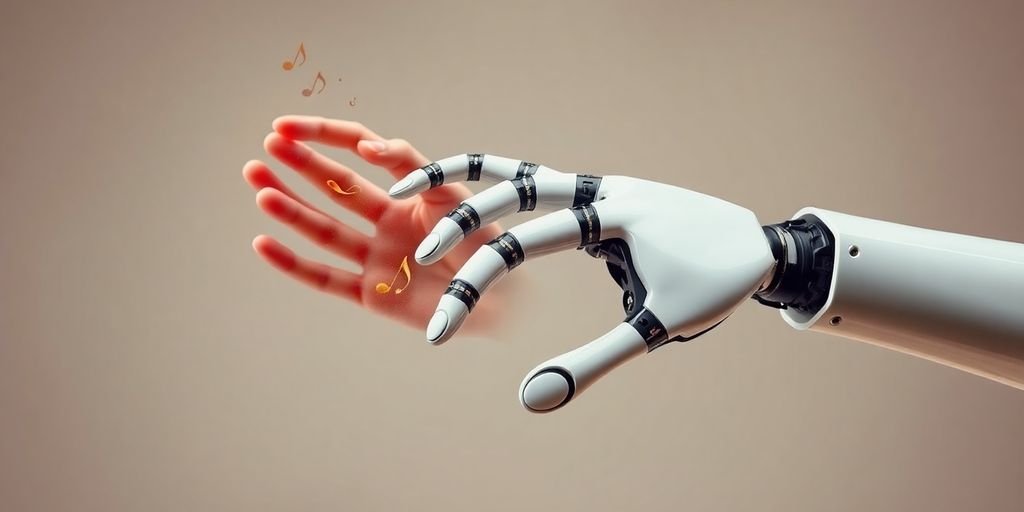
So, you've heard about AI making music, right? It's not just some futuristic fantasy anymore; it's happening now, and it's pretty wild. Forget those old sci-fi movies where robots just made weird noises. Today's AI can actually whip up tunes that sound, well, good. It’s like having a super-powered musical assistant who never sleeps and knows every song ever written.
The Algorithm's Ascent: How AI Learned to Rock
Think of it like this: AI has been listening to a ton of music – like, more music than you could listen to in a million lifetimes. It’s analyzed everything from classical symphonies to the latest pop hits, figuring out what makes a melody catchy, what chord progressions hit just right, and how to build a beat that makes you want to move.
Here’s a peek at how it’s gotten so good:
- Data Deluge: AI needs fuel, and for music, that fuel is data. Massive libraries of songs, from every genre imaginable, are fed into these systems. The more data, the smarter the AI gets at understanding musical patterns.
- Pattern Recognition: AI algorithms are like super-detectives for music. They spot recurring themes, harmonic structures, and rhythmic sequences that humans might miss or take ages to analyze.
- Generative Power: Once it understands the patterns, AI can start creating its own. It’s not just copying; it’s remixing, reinterpreting, and coming up with entirely new musical ideas based on what it’s learned.
It’s a bit like learning to cook. You start by following recipes (data), then you understand how ingredients work together (patterns), and eventually, you can create your own dishes (new music).
Data Deluge: The Fuel for AI's Musical Fire
Seriously, the amount of music data out there is staggering. Streaming services, digital archives – it’s all a goldmine for AI. This massive collection allows AI to learn the nuances of different genres, the emotional impact of certain melodies, and even the subtle variations in instrumental performances. It’s this vast digital library that allows AI to generate music that feels surprisingly human.
Tech That Tunes: Synthesizers and Signal Processing
Beyond just the algorithms, the actual sound of AI music is thanks to some seriously clever tech. Modern synthesizers and digital signal processing (DSP) are key players here. They allow AI to not only compose notes but also to craft incredibly realistic instrument sounds, create unique sonic textures, and even manipulate audio in ways that were previously impossible. So, when you hear an AI-generated track, it’s not just a bunch of notes; it’s a carefully crafted soundscape brought to life by cutting-edge technology.
Human Meets Machine: The Ultimate AI Music Collaboration
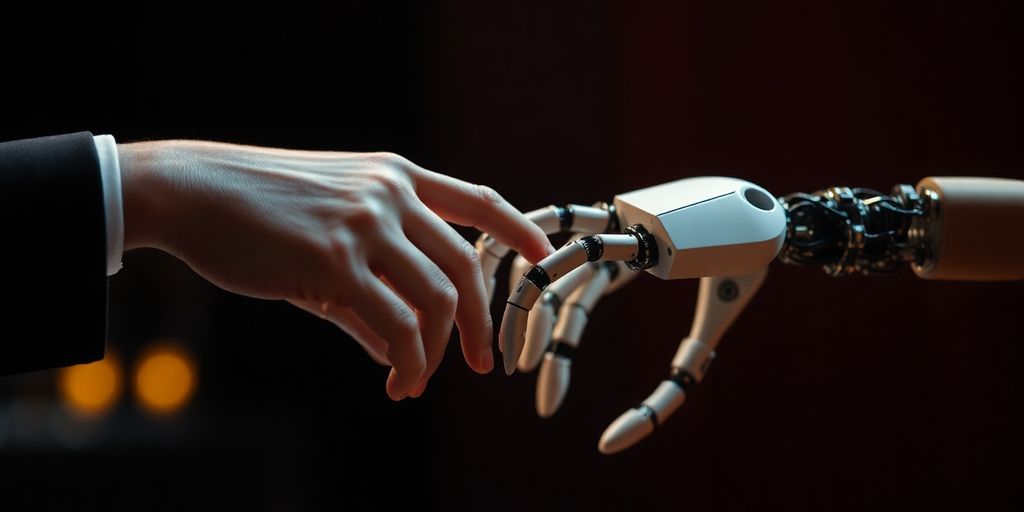
So, you've been messing around with AI music tools, right? It's pretty wild how these algorithms can whip up beats and melodies that actually sound good. But here's the thing: AI isn't just about replacing humans; it's about teaming up. Think of it like having a super-talented, slightly quirky bandmate who never sleeps and has listened to literally every song ever made. Pretty sweet deal, huh?
Blurring the Lines: Creativity Meets Computation
Remember when computers just made weird beeping noises? Yeah, we've come a long way. Now, AI can analyze massive amounts of music, learn patterns, and spit out something totally new. It's like the AI went to music school, but instead of practicing scales, it just absorbed the entire internet's music library. This means you can give it a mood, a genre, or even just a few notes, and it can build a whole track around it. It’s not just about making sounds; it’s about creating music, and the line between what a human made and what an AI helped create is getting fuzzier by the day.
The Beatles' AI Encore: Saving Music from the Dustbin
This is where things get really cool. You know how some old recordings are just… rough? Like, you can barely hear the vocals over the crackle and hiss? Well, AI can actually go in there and clean that stuff up. The Beatles famously used AI to isolate John Lennon's voice from a demo tape for their song "Now And Then." They basically used AI to pull his voice out of the noise, letting Paul McCartney and Ringo Starr add new parts. It’s like a musical time machine, bringing classic sounds back to life and letting us hear music that might have otherwise been lost forever. Pretty neat, right?
Your Personal AI Bandmate: Making Music Accessible
Let's be honest, not everyone can play the guitar like Jimi Hendrix or sing like Freddie Mercury. But what if you have a killer idea for a song? AI tools are making it way easier for anyone to get involved in music creation. You don't need to spend years learning an instrument or complex music software. You can just use AI to help you lay down the tracks, experiment with different sounds, and bring your musical vision to life. It’s like having a studio in your pocket, ready to help you jam whenever inspiration strikes. This democratization of music creation is seriously changing the game.
The Brains Behind the Beats: Technologies Powering AI Music
So, you're curious about what makes these AI music-making machines tick, right? It's not just magic, though sometimes it feels like it! Think of it like this: you've got these super-smart computer brains, and we're going to peek under the hood to see the tech that powers them. It’s a wild ride from simple algorithms to the complex systems we have today.
Machine Learning: The Maestro's Secret Sauce
This is where the AI starts to get its groove on. Machine learning is basically teaching the computer to learn from tons of music. It sifts through all those notes, rhythms, and harmonies, figuring out what makes a song sound good. The more music it hears, the better it gets at creating its own. It’s like your favorite DJ who knows exactly what track to play next based on the crowd’s vibe.
Deep Learning: Unlocking Complex Compositions
Now, deep learning is like machine learning’s super-powered older sibling. It uses layers upon layers of artificial neural networks – think of them as tiny digital brains – to understand really intricate musical patterns. It can grasp the subtle nuances that make a piece of music truly special, going way beyond just basic chords and melodies. It’s how AI can start to mimic the emotional depth you find in human-created music.
Neural Networks: Mimicking the Human Mind's Melody
Speaking of neural networks, these are the real MVPs. We're talking about things like Recurrent Neural Networks (RNNs) and Long Short-Term Memory (LSTM) networks. RNNs are great for handling music that unfolds over time, like a melody. LSTMs are even cooler because they can remember things from way back in the song, which is super important for keeping a consistent musical idea going. It’s like the AI has a memory for music, just like you do when you’re humming your favorite tune.
Natural Language Processing: When AI Writes the Lyrics
Ever wonder how AI can whip up lyrics that actually make sense? That’s where Natural Language Processing (NLP) comes in. NLP helps the AI understand human language, its structure, and its meaning. So, when you ask it to write a song about a rainy Tuesday, it doesn't just string random words together; it tries to capture the mood and tell a story. It’s pretty wild to think an algorithm can get poetic!
Generative Adversarial Networks: The Art of AI's Musical Arms Race
This one sounds like a sci-fi movie title, right? Generative Adversarial Networks, or GANs, are like two AIs having a musical showdown. One AI, the ‘generator,’ tries to create music, and the other, the ‘discriminator,’ tries to tell if it’s real or fake. They keep challenging each other, and through this constant battle, the generator gets incredibly good at making music that sounds super authentic. It’s a clever way to push the AI to its creative limits.
Can AI Really Drop the Next Platinum Hit?
So, can AI actually cook up the next chart-topper? It’s the million-dollar question, right? Think about it: we’ve already seen AI help bring the Beatles back from the dead, digitally speaking. That’s pretty wild. AI can sift through mountains of music, learn what makes a hit tick, and then spit out something new. It’s like having a super-smart music theory student who never sleeps.
The AI DJ: Your Personalized Sonic Guide
Ever feel like your music app just gets you? That’s AI working its magic. Services like Spotify’s AI DJ learn your listening habits faster than you can say "repeat." It figures out what you’re into, when you’re into it, and serves up a personalized soundtrack for your day. It’s like having a buddy who knows all your favorite obscure bands, but this buddy is an algorithm. Pretty neat, huh?
Generative Adversarial Networks: The Art of AI's Musical Arms Race
This is where things get really interesting, and maybe a little sci-fi. Generative Adversarial Networks, or GANs, are like two AIs playing a game of cat and mouse. One AI tries to create music, and the other tries to tell if it’s real or fake. This constant back-and-forth pushes the music-creating AI to get seriously good, making its output sound more and more human. It’s a bit like an artistic arms race, but with way more synthesizers.
Natural Language Processing: When AI Writes the Lyrics
What about the words? AI isn’t just about beats and melodies anymore. With Natural Language Processing (NLP), AI can actually write lyrics. Imagine feeding an AI a theme or a mood, and it churns out verses and choruses. It’s still early days, and sometimes the results are a bit… abstract. But hey, sometimes the weirdest lyrics make the best songs. Plus, it’s a fantastic tool for songwriters who hit a wall and need a fresh perspective, or maybe just a really bizarre rhyme.
Here’s a quick look at how AI is changing music creation:
- Composition: AI can generate melodies, harmonies, and even full song structures.
- Sound Design: Creating unique instrument sounds or vocal effects that humans might not even think of.
- Production Assistance: Helping with mixing, mastering, and arrangement to speed up the workflow.
- Lyric Writing: Crafting lyrical content based on prompts or existing styles.
While AI can churn out tunes and even lyrics, the human element – the raw emotion, the lived experience, the sheer soul – is still what makes music truly connect. AI is a powerful tool, a collaborator, but maybe not the sole artist just yet. It’s about the partnership, you know?
The Future is a Duet: AI and Human Harmony
So, what's next for music when AI is practically a bandmate? It's not about AI taking over, but more like a really talented, if slightly quirky, collaborator. Think of it as having a super-powered assistant who can whip up endless variations of a melody or suggest harmonies you'd never dream of. The future of music is definitely a duet, a real back-and-forth between human feeling and machine precision.
Beyond the Studio: AI in Virtual and Augmented Reality
Imagine going to a concert not just by watching a screen, but by actually being there. AI is already making this possible, blending virtual and augmented reality to create experiences that are wild. You could be in a VR space, walking through the artist's creative process, or have AR elements pop up around you that sync with the music. It's like the music isn't just something you hear, but something you can step inside and interact with. Pretty neat, huh?
The Symbiotic Symphony: Where Emotion Meets Algorithm
This is where things get really interesting. AI can analyze massive amounts of music, learning patterns and structures. But it doesn't feel heartbreak or the sheer joy of a sunny day. That's where you come in. You bring the raw emotion, the lived experience, and the AI helps you translate that into sound in ways that might have been impossible before. It's like giving your feelings a super-powered paintbrush.
Will AI Steal the Spotlight? Navigating the Musician's Dilemma
Okay, let's be real. There's always that little worry: will AI make human musicians obsolete? It's a valid question. But think about it – a perfectly synthesized voice might hit every note, but does it have the grit, the imperfections, the soul that makes a human performance unforgettable? Probably not. The challenge for musicians is to figure out how to use AI as a tool, not a replacement. It's about augmenting your own creativity, not handing it over. You're still the artist, the AI is just your really, really advanced instrument.
The future is looking bright as AI and people work together. Imagine computers and humans teaming up to create amazing things, like music or art. It's like a cool partnership where both sides bring something special to the table. This teamwork can help us solve problems and come up with new ideas faster than ever before. Want to see how this blend of tech and talent can boost your own creativity? Check out our awesome loop kits to get started!
So, What's Next for Your Tunes?
Alright, so we've jammed with AI, explored its history, and seen how it's basically becoming your new bandmate. It's pretty wild, right? You can whip up beats, find new sounds, and honestly, just have a blast making music without needing a degree in music theory. Think of it as your super-powered creative sidekick. So go ahead, mess around with these tools, see what weird and wonderful stuff you can cook up. Who knows, maybe you'll accidentally invent the next big genre. Just don't blame us if your AI collaborator starts demanding royalties or a solo. Happy creating!
Frequently Asked Questions
How did AI start making music?
Think back to the 1950s! That's when computers first started making sounds, kind of like humming a tune. By the 1960s, they were getting better at recognizing musical patterns and creating new tunes. Then, in the 1980s, things like MIDI came along, which let different music devices talk to each other, and programs like Emmy started creating music in the style of famous composers.
What makes AI music generators so advanced?
AI music makers are way more than just simple beeps. They use super smart computer programs called algorithms that learn from tons of music. It's like they study all the songs ever made to understand how music works. Plus, new tech like synthesizers and special sound tools help make the AI music sound really good and realistic.
How does AI help people make music together?
It's awesome! AI can help you come up with song ideas, create melodies, or even finish a track. Imagine having a digital bandmate that never gets tired and can play any style you want. This makes making music way easier for everyone, even if you don't play an instrument.
What tech powers AI music?
The magic behind AI music is really about smart computer learning. Machine learning helps AI understand music patterns, while deep learning lets it grasp really complex song structures. Neural networks are like the AI's brain, trying to think like a human musician to create melodies.
Can AI really make a hit song?
It's definitely possible! AI can create catchy tunes and even write lyrics using something called Natural Language Processing. Plus, there's a cool tech called Generative Adversarial Networks (GANs) where two AIs kind of compete to make the best music. And think about AI DJs that learn what you like and play music just for you!
What's next for AI and music?
The future looks like a big duet! AI will likely be used in cool ways in virtual worlds, like concerts you can walk through. It's all about humans and AI working together, mixing feelings with smart computer code. While AI is getting really good, the human touch – the emotion and soul – is still super important in music.


